




Toyota unveiled the all-new, 9th generation Hilux, the latest iteration of a global best-seller that’s designed to be a “partner for life.” Built on the brand’s foundations of Quality, Durability, and Reliability, it fuses everyday toughness with a bold, future-focused design language and a potent powerplant.

Designed to meet the diverse requirements of customers around the world, the new Hilux emphasizes Toyota’s multi-pathway approach by offering both internal combustion engine (ICE) and battery electric (BEV) variants from the get-go. The all-new Hilux is now on sale in Thailand (December 10 for the Hilux EV) and starting in fiscal year 2026 (April 1, 2026 onwards) for global markets, including the Philippines.

Built on an improved version of the versatile Innovative International Multi-purpose Vehicle (IMV) platform, the all-new Hilux represents the accumulated years of listening, learning, and developing vehicles that truly serves the needs and requirements of its customers.

“For the new model, we travelled extensively across the region from the deserts of the Middle East, the highlands of South America, to the bush of Africa, to the outback of Australia and the icy extremes of Europe. Every market is unique. We learned from the roads, climates, and customer lifestyles—and those insights became our ‘blueprint.’ That’s why we have developed the new Hilux regionally to tailor to local conditions while upholding Toyota’s global standards in safety and performance,” reveals Ms. Anyarat Sutthibenjakul, Regional Chief Engineer, Toyota Motor Asia Co., Ltd.

Toyota refers to this practice as, “Genchi Genbutsu,” a unique company philosophy where they evaluate things with their own eyes and ears to respond to customers’ needs, whoever and wherever they are. It’s something that started with Toyota’s founder, Kiichiro Toyoda. When Toyota started producing the Type G1 Truck in 1935, it suffered breakdown after breakdown. Instead of ignoring the faults, Kiichiro himself rushed to the scene each time. Kiichiro understood the importance of going to see things for oneself to understand the circumstances of a vehicle’s breakdown with a desire to improve. That desire for improvement is now known as “Monozukuri,” a synthesis of technological expertise, skill, and a dedication to continuous improvement towards perfection.


For the 9th generation Hilux, it’s reflected in the various changes and improvements Toyota has done underneath. The platform’s body in white (the basic skeletal structure) is lighter, yet more rigid than the current Hilux. It features more spot welds, particularly in the floor for added strength.

From there, Toyota has opted to employ different suspension tunings across the range. Fleet-oriented models, for example, have their independent Double Wishbone and rear Leaf Spring suspension geared for heavy load carrying and towing. On the other hand, lifestyle-oriented variants feature what’s called, at least in Thailand, Dynamic Cloud technology which uses different spring rates and an optimized suspension stroke for enhanced riding comfort.

There are also new hydraulic engine mounts and shear-type cabin mounts to help further reduce vibrations. Even the front suspension tower thickness has been increased and the number of fitting bolts increased from three to four to quell unwanted vibrations and to accommodate the new electric power steering system. The two frontal frame cross members have also been revised for better crash safety. To cap it all off, the seat mounting and seat design has been changed to improve comfort.
Underneath the hood, the Hilux comes standard with an improvement version of the 2.8-liter GD engine. The “Super Power” engine provides both high power (204 horsepower and 500 Nm of torque) and improved fuel efficiency—up to 5.8 percent more efficient than the current 2.4-liter turbo diesel and 7.5 percent more efficient than the current 2.8-liter thanks in part to an idle start-stop feature. Depending on the variant, the available transmissions are a 6-speed manual or 6-speed automatic.

Alongside the diesel-powered Hilux, a new battery electric version has also been introduced. This BEV variant, officially called the “Hilux Travo-e” in Thailand (Hilux EV elsewhere) becomes the brand’s first commercially available body-on-frame BEV. The Hilux EV delivers instant torque and quiet performance with zero tailpipe emissions while maintain the core capabilities known of the model such as off-road articulation (500 mm), water wading (700 mm), towing (2,000 kilograms) and payload capacity (715 kilograms). The dual motor configuration makes 196 horsepower in total and thanks to a 52.9-kWh battery it can go up to 315 kilometers on a single charge. A Diamond Guard offers robust underbody protection for the battery giving peace of mind, even during off-road driving.

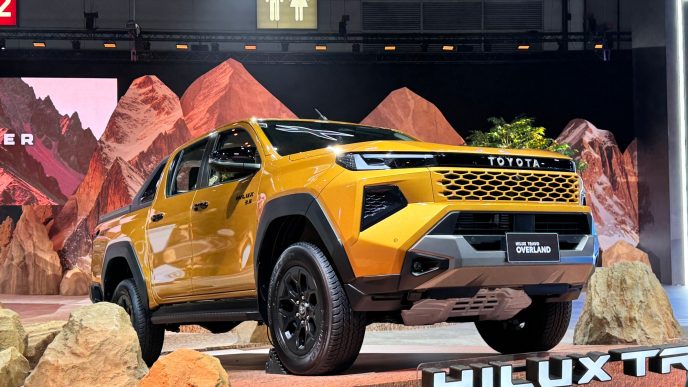
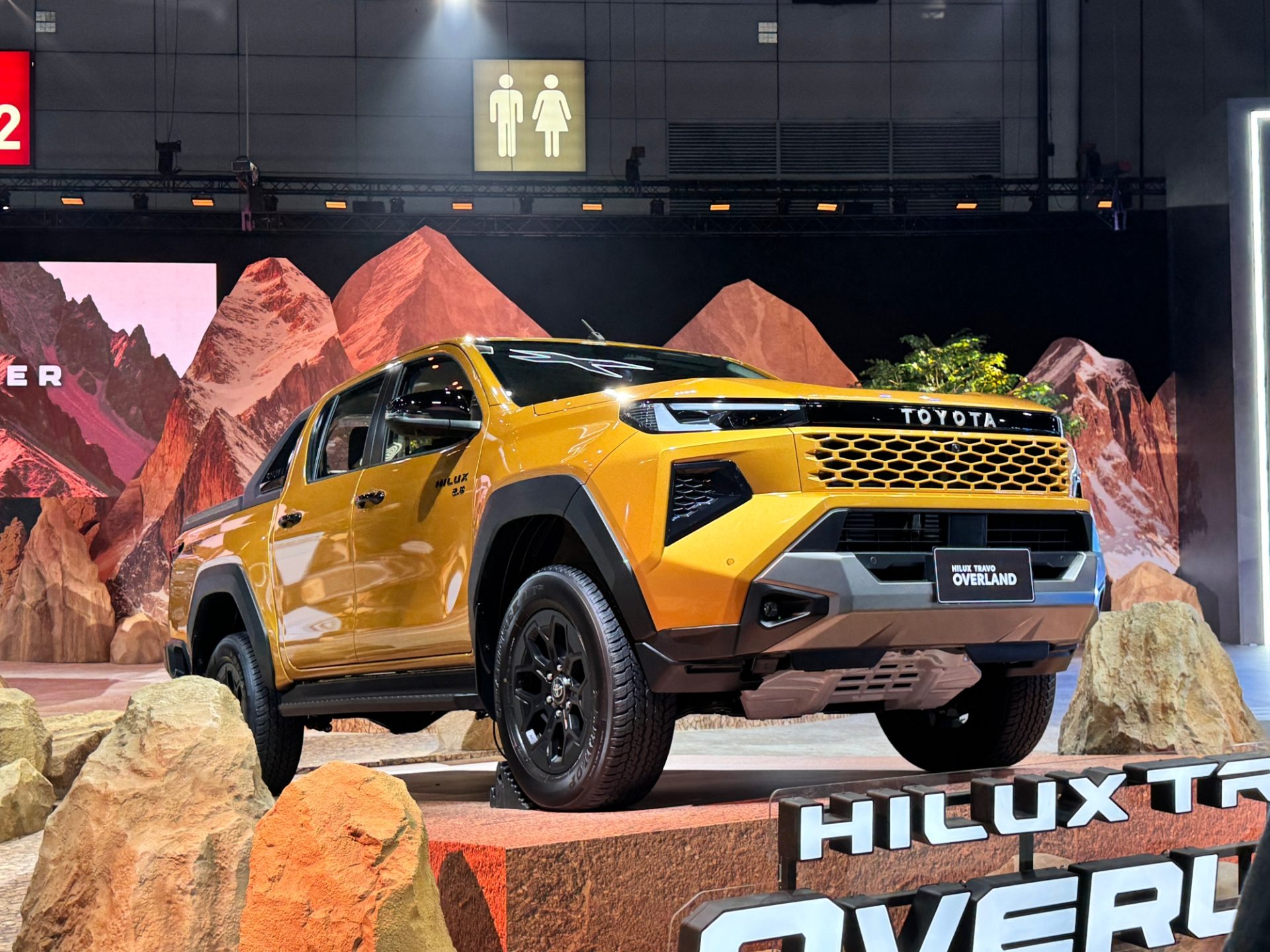
The all-new Hilux comes with a “Tough and Agile” design concept. The “Cyber Sumo” front-end is so-named for the sumo wrestler’s pre-combat Shikiri Stance. This emphasizes the Hilux’s three core characteristics: Stable, Strong, and Steady. The slimmed down grille with the two-volume architecture make it look distinctive along pickup trucks, while it drops the Toyota “T” logo for the words, “TOYOTA” spelled out both on the front and the back.
Meanwhile, inside, it uses the “Robust Simplicity” approach, doubling down on practical usefulness without sacrificing modernity. The design is meant to be ergonomic yet filled with new levels of technology with an electronic parking brake with auto hold, wireless charger, large digital instrument cluster (up to 12.3-inch) and large free-standing infotainment touchscreen (up to 12.3-inch). USB Type C chargers are found front and back, and dual zone climate control with rear vents is an available feature.


Both the Hilux and the Hilux EV come with a next-generation infotainment system with smartphone integration and connected services that enhance the ownership experience throughout its lifecycle. It also has Panoramic View Monitor and Multi-Terrain Monitor for superior visibility and control in all situations, and Toyota Safety Sense 3 with enhanced pre-collision and lane-keeping functions.
Quality, Durability, and Reliability sound so simple, but it’s something Toyota has nurtured and cultivated for close to 90 years. QDR are intangible traits; something the human senses cannot easily perceive. Yet, it’s found in the DNA of every vehicle they build. Toyota sees these values as universal, timeless, and above all, genuine.
It’s for this reason how Toyota has managed to ingrain itself in culture across generations; that they’ve become a brand synonymous with trust. Whether it’s your lolo and lola, your father and mother, your sibling, or maybe your children—chances are they’ve ridden or owned a Toyota, and they’ve come to depend on them.
That same energy flows in the Hilux, helping keep it relevant, dependable, and ground in real needs. The first Hilux was created to empower people and enrich communities. And with every generation, it continues to be shaped by the roads and environments it traverses in, but most of all, it’s shaped by the voices of its customers.


The Hilux has continuously evolved in step with the changing context of society and the world. Toyota has listened—to the miners who demanded toughness, to families seeking greater comfort, to fleet owners who valued fuel economy, and to young adventurers who wanted design and technology that suit their lifestyles. The result is a vehicle people can always rely on—connecting them to opportunities by being strong, simple, and built to last.
And the story of the Hilux doesn’t end here—in fact, it’s a story that’s never done. While others seek only to better themselves, sometimes at the expense of caring about what customers need and require, Toyota listens. For as long as customer needs continue to evolve, the Hilux will keep evolving alongside them, to serve communities across the globe from Australia, South America, and South Africa, to Europe and Asia. It is, and will always remain true to its unchanging promise of being everyone’s life partner.